Sunday, May 05, 2013

RDoC Dimensional Approach for Research vs. DSM-5 for Diagnosis


Dr. Thomas Insel, director of the National Institute of Mental Health (NIMH) in the U.S., recently announced that NIMH will be re-orienting its research away from DSM categories:
...While DSM has been described as a “Bible” for the field, it is, at best, a dictionary, creating a set of labels and defining each. The strength of each of the editions of DSM has been “reliability” – each edition has ensured that clinicians use the same terms in the same ways. The weakness is its lack of validity. Unlike our definitions of ischemic heart disease, lymphoma, or AIDS, the DSM diagnoses are based on a consensus about clusters of clinical symptoms, not any objective laboratory measure. In the rest of medicine, this would be equivalent to creating diagnostic systems based on the nature of chest pain or the quality of fever. Indeed, symptom-based diagnosis, once common in other areas of medicine, has been largely replaced in the past half century as we have understood that symptoms alone rarely indicate the best choice of treatment.

Patients with mental disorders deserve better. NIMH has launched the Research Domain Criteria (RDoC) project to transform diagnosis by incorporating genetics, imaging, cognitive science, and other levels of information to lay the foundation for a new classification system. Through a series of workshops over the past 18 months, we have tried to define several major categories for a new nosology...

The dimensional approach to studying mental illness was covered in an excellent new blog post by Dr. Russ Poldrack, who describes ongoing work including the Consortium for Neuropsychiatic Phenomics and the Cognitive Atlas project.

I first wrote about the Research Domain Criteria for Classifying Mental Disorders in 2010:
There is no absolute timeline of when these [research] advances might occur. Instead of providing an immediate replacement for DSM and its clinical diagnoses, RDoC is a long-term project to help the research community by defining more biologically based organizational principles for various psychopathologies...

NIMH has been preparing the RDoC criteria for the past 2-3 years, as you can see in the RDoC Publications and in these Proceedings of RDoC Workshops (scroll down). Requests for applications (RFAs) on Dimensional Approaches to Research Classification in Psychiatric Disorders date back to 2011. The workshops and publications haven't been a secret, they've been available all along.1

Nonetheless, Insel's announcement was treated as a "bombshell", a "potentially seismic move", and a "humiliating blow to the APA." But as 1 Boring Old Man notes, this is old news.

One of the more alarmist posts on the topic was by John Horgan:
Psychiatry in Crisis! Mental Health Director Rejects Psychiatric “Bible” and Replaces With… Nothing

. . .

Now, in a move sure to rock psychiatry, psychology and other fields that address mental illness, the director of the National Institutes of Mental Health has announced that the federal agency–which provides grants for research on mental illness–will be “re-orienting its research away from DSM categories.” Thomas Insel’s statement comes just weeks before the scheduled publication of the DSM-V, the fifth edition of the Diagnostic and Statistical Manual.

Note the foreshadowing here: I do think Dr. Insel's timing in announcing the dimensional RDoC was a deliberate attempt to blunt the media circus that will surround the big DSM-5 release at the APA meeting in 2 weeks.

However, Horgan thinks the timing was more related to President's Obama's ambitious new BRAIN Initiative when he says:
NIMH director Insel doesn’t mention it, but I bet his DSM decision is related to the big new Brain Initiative, to which Obama has pledged $100 million next year. Insel, I suspect, is hoping to form an alliance with neuroscience, which now seems to have more political clout than psychiatry.

This is utterly preposterous, since NIMH has been aligned with "neuroscience" for years (which is apparent when looking at funded projects).2 And by "political clout" I assume he means the Society for Neuroscience has more political clout than the American Psychiatric Association (APA). However, it's not likely that NIMH has abandoned APA.

1 Boring Old Man goes much further and points out that A Research Agenda for DSM-V (2002) was a collaboration between APA and NIMH:
Do they really think that we won’t notice that the APA and NIMH are working in tandem – that their efforts are coordinated? Do they think we won’t notice that the "cross cutting" dimensional scheme for the DSM-5 that got dropped is the same idea as the RDoC? The articles that have been popping up all day are playing this as Insel’s NIMH throwing the DSM-5 under the bus. No need. The DSM-5 is already under the bus where it belongs.

bus image © BrokenSphere / Wikimedia Commons


Footnotes

1 All this activity might not have been apparent to those outside the U.S. funding system, however. Or to the majority of the planet who haven't read old blog posts on the topic.

2 On the front page of NIH RePORTER, search 'NIMH' and '1989' (the oldest date available).

Subscribe to Post Comments [Atom]

Wednesday, May 15, 2013

What RDoC Research Might Look Like

I'm Blogging for Mental Health.

The month of May is a violent thing
In the city their hearts start to sing
Well, some people sing, it sounds like they're screaming
I used to doubt it, but now I believe it

Month Of May
   ------The Arcade Fire

Today is Mental Health Month Blog Day, sponsored by the American Psychological Association (APA). It's designed to:
...educate the public about mental health, decrease stigma about mental illness, and discuss strategies for making lasting lifestyle and behavior changes that promote overall health and wellness.

If the public has been following the recent hullabaloo about how to diagnose mental illnesses, they might be confused about the current and future direction of the field. How did we get here?

As most of you know, the American Psychiatric Association (the other APA) is about to release its updated Diagnostic and Statistical Manual of Mental Disorders, the much maligned DSM-5. Weeks before the big launch, however, the National Institute of Mental Health (NIMH) stole the show by announcing that it will be re-orienting its research away from DSM categories:
...While DSM has been described as a “Bible” for the field, it is, at best, a dictionary, creating a set of labels and defining each. The strength of each of the editions of DSM has been “reliability” – each edition has ensured that clinicians use the same terms in the same ways. The weakness is its lack of validity. Unlike our definitions of ischemic heart disease, lymphoma, or AIDS, the DSM diagnoses are based on a consensus about clusters of clinical symptoms, not any objective laboratory measure.

Instead, the Research Domain Criteria (RDoC) framework would become the preferred method for organizing biologically-based research on mental illnesses, with the ultimate goal of constructing a new classification scheme.

This caused quite a commotion, leading many to comment on NIMH's shocking repudiation of DSM-5. However, to long-time observers of RDoC's development, this was not a surprise. And the initial lack of clarity on the distinction between the RDoC Dimensional Approach for Research vs. DSM-5 for Diagnosis didn't help matters, nor did the uncertainty about whether NIMH would fund DSM-based research at all.1

NIMH issued a press release on May 13 to clarify its position:
DSM-5 and RDoC: Shared Interests

Thomas R. Insel, M.D., director, NIMH
Jeffrey A. Lieberman, M.D., president-elect, APA

NIMH and APA have a shared interest in ensuring that patients and health providers have the best available tools and information today to identify and treat mental health issues, while we continue to invest in improving and advancing mental disorder diagnostics for the future.

Today, the APA's Diagnostic and Statistical Manual of Mental Disorders (DSM), along with the International Classification of Diseases (ICD) represents the best information currently available for clinical diagnosis of mental disorders  Patients, families, and insurers can be confident that effective treatments are available and that the DSM is the key resource for delivering the best available care. The NIMH has not changed its position on DSM-5. As NIMH’s Research Domain Criteria (RDoC) project website states, “The diagnostic categories represented in the DSM-IV and the International Classification of Diseases-10 (ICD-10, containing virtually identical disorder codes) remain the contemporary consensus standard for how mental disorders are diagnosed and treated.”

Yet, what may be realistically feasible today for practitioners is no longer sufficient for researchers. Looking forward, laying the groundwork for a future diagnostic system that more directly reflects modern brain science will require openness to rethinking traditional categories. It is increasingly evident that mental illness will be best understood as disorders of brain structure and function that implicate specific domains of cognition, emotion, and behavior. This is the focus of the NIMH’s Research Domain Criteria (RDoC) project. RDoC is an attempt to create a new kind of taxonomy for mental disorders by bringing the power of modern research approaches in genetics, neuroscience, and behavioral science to the problem of mental illness.

So what is RDoC, and how might it be applied to new research projects? From the DSM perspective of categorical disorders (e.g, schizophrenia, major depression, and obsessive compulsive disorder), RDoC embraces diagnostic messiness. Patients previously excluded from a study due to comorbidities, or because they don't meet full criteria? Misfits from the "Not Otherwise Specified" (NOS) category? Now they're in. Specifically, the instructions for RFA-MH-14-050 state:
Priority will be given to applications that have a well-justified plan to include patients from multiple diagnostic groups (including Not Otherwise Specified and forme fruste diagnoses) as appropriate for explicating the dimensions and constructs of interest in the study design. Studies that include patients from a single diagnostic group may also be considered if there is a particularly strong justification for examining constructs of interest within one diagnostic category.  A defensible approach might be to study all patients presenting themselves at a specialty clinic, e.g., mood disorders clinic, anxiety clinic, or psychotic disorders clinic, regardless of whether they meet criteria for a particular DSM diagnosis.

One potential pitfall of this approach is the money required to enroll huge numbers of patients. If commonalities in cognitive function or brain circuitry or especially genetic risk factors are to emerge from studying all patients with mood disorder-like symptoms, then sample sizes must be very large to overcome potential noise in the system(s).

The applicant would propose to study one or more of the five different domains, or constructs, that have been fleshed out at NIMH Workshops:

Negative Valence Systems
Positive Valence Systems
Cognitive Systems
Systems for Social Processes
Arousal/Regulatory Systems

The possible units of analysis run the gamut from genes to circuits to behavior, and the studies should use specific tasks (paradigms) and self-report measures, as shown in the Negative Valence Systems matrix below.


Animal models of active threat ("fear") like the startle response are pretty well established and would allow a much more detailed analysis of mechanisms, from genes to behavior. In the realm of human research, one example of a proposed project for RFA-MH-14-050 is:
  • Evaluation of the relationship between measures of exaggerated fear response, reports of overall distress and anxiety, and chronicity of internalizing disorders
This project could study common and unique aspects of the startle response in patients with phobias, panic disorder, OCD, generalized anxiety, and major depression ("internalizing disorders"), as described in this review article (Vaidyanathan et al.  2011).

Another recent review tackles the neurobiology of reward, which falls under the rubric of Positive Valence Systems. It's a 43 page tour de force with 756 references (Dichter et al., 2012):
This review summarizes evidence of dysregulated reward circuitry function in a range of neurodevelopmental and psychiatric disorders and genetic syndromes. First, the contribution of identifying a core mechanistic process across disparate disorders to disease classification is discussed, followed by a review of the neurobiology of reward circuitry. We next consider preclinical animal models and clinical evidence of reward-pathway dysfunction in a range of disorders, including psychiatric disorders (i.e., substance-use disorders, affective disorders, eating disorders, and obsessive compulsive disorders), neurodevelopmental disorders (i.e., schizophrenia, attention-deficit/hyperactivity disorder, autism spectrum disorders, Tourette’s syndrome, conduct disorder/oppositional defiant disorder), and genetic syndromes (i.e., Fragile X syndrome, Prader–Willi syndrome, Williams syndrome, Angelman syndrome, and Rett syndrome). We also provide brief overviews of effective psychopharmacologic agents that have an effect on the dopamine system in these disorders. This review concludes with methodological considerations for future research designed to more clearly probe reward-circuitry dysfunction, with the ultimate goal of improved intervention strategies.

The idea is to find common neurobiological substrates of altered reward circuitry that cut across DSM-esque categories (e.g., drug and alcohol use disorders, serious gambling problems, mania), where individuals seek out reward without regard to the consequences. At the other end of the spectrum is anhedonia, or the inability to feel pleasure from previously rewarding activities. Anhedonia is often (but not always) seen in major depression and schizophrenia, two disorders usually considered to have little overlap.

Will RDoC succeed in carving out a new nosology and generating a new guidebook? Will it lead to diagnostic tests that can identify specific cognitive, emotional, motivational, or social weaknesses that can be treated with targeted pharmaceuticals, deep brain stimulation, and/or improved psychotherapies?

This quote from Chapter 1 of a 2002 white paper collection indicates the DSM-5 revision committee (a joint APA / NIMH production) didn't exactly expect that all of its goals would be reached (PDF):
"Given the relatively short time frame for generating breakthrough research findings between now [1999] and the probable publication of DSM-V in 2010 [2013], it is anticipated that some of the research agendas suggested in these chapters might not bear fruit until the DSM-VI or even DSM-VII revision processes!"

So don't hold your breath, unless you want to experience severe anoxia.


Footnotes

1 See the Appendix for a compendium of quotes.


References

Dichter, G., Damiano, C., & Allen, J. (2012). Reward circuitry dysfunction in psychiatric and neurodevelopmental disorders and genetic syndromes: animal models and clinical findings Journal of Neurodevelopmental Disorders, 4 (1) DOI: 10.1186/1866-1955-4-19

Vaidyanathan, U., Nelson, L., & Patrick, C. (2011). Clarifying domains of internalizing psychopathology using neurophysiology Psychological Medicine, 42 (03), 447-459 DOI: 10.1017/S0033291711001528


Appendix

May 6
Matthew Herper (Forbes reporter covering science and medicine): “I spoke to NIMH. This is a broadening, not an exclusion.” ...

DSM-5 Task Force member Dr.  David J. Kupfer strikes back in the NYT, blaming NIMH and the sluggish rate of scientific progress: “The problem that we’ve had in dealing with the data that we’ve had over the five to 10 years since we began the revision process of D.S.M.-5 is a failure of our neuroscience and biology to give us the level of diagnostic criteria, a level of sensitivity and specificity that we would be able to introduce into the diagnostic manual.”


May 7
“Some people have the idea that we’re trying to ditch or diss the DSM and that’s not a fair assessment,” says Insel.

Dr. Bruce Cuthbert: “The sensationalist headlines out there are entirely misleading, and we will continue to support DSM-based research as we increase our portfolio of RDoC grants. RDoC is intended to inform future versions of the ICD and DSM; we have no intention of coming out with a competing system. The implication of this is that the fruits of RDoC are likely to be taken up into the ICD/DSM piecemeal rather than in one entire set, at such times as the evidence for various aspects becomes strong enough to warrant changes to the nosologies.”

Dr. Thomas Insel: “We cannot ‘ditch’ or ‘reject’ terms like schizophrenia or bipolar. We just need to view them as constructs, perhaps including many different disorders that require different treatments or obscuring disorders than cut across the current categories. A symptom-only system will not be sufficient for identifying brain disorders—whether the initial label is dementia or schizophrenia.”

Dr. Cuthbert: “As with most shifts in science, changes in research priorities require a transition. Because almost all clinical researchers today grew up with the DSM system both clinically and in research, it will take some time to get a “feel” for the relationships between DSM disorders and various kinds of RDoC phenomena (both in terms of the types of symptoms, and in overall severity), learn how to write grant applications with the new criteria, and evolve new review criteria. So, there will be a period of some time while these crosswalks are worked out.”


May 8
Dr. Cuthbert: “Using DSM diagnoses for research has become a de facto standard ever since the DSM-III came out in 1980. What we are trying to do is to study neural systems directly because they cut across lots of the dsm disorders. ... We are moving in a new direction. That doesn’t mean that next month we’ll stop accepting DSM diagnoses. It rather is a shift in emphasis.”

Subscribe to Post Comments [Atom]

Friday, November 05, 2010

Research Domain Criteria for Classifying Mental Disorders

"The more a delusion is investigated, the more understandable and less bizarre it becomes, often interwoven with the very individual patterns of experiencing relationships, adversities and suffering, and finally, for every delusional content, as bizarre and remote as it may appear, there may be a cultural niche, in which the same content may be considered legitimate and reasonable."

-Pfeifer (1999), Demonic Attributions in Nondelusional Disorders.


What is psychopathology?

According to Wikipedia,
Psychopathology is the study of mental illness, mental distress and abnormal, maladaptive behavior. The term is most commonly used within psychiatry where pathology refers to disease processes. Abnormal psychology is a similar term used more frequently in the non-medical field of psychology.
But what is "abnormal, maladaptive behavior"? That's such an enormously complicated question that I wouldn't know where to begin. In fact, as a non-clinician I think it would be rather pompous of me to try and define the parameters of what is (and is not) pathological. For that I refer the reader to the ICD-10 or the Diagnostic and Statistical Manual of Mental Disorders (DSM), both voluminous (and imperfect) attempts to diagnose mental illness based on signs and symptoms. As most of you know, the DSM-IV is currently in the process of being revised. The DSM-5 will be the controversial new revision, with a (delayed) publication date of May 2013.

The National Institute of Mental Health (NIMH) in the U.S. is starting to take a different approach to the classification of psychiatric disorders, one that incorporates dimensions of observable behavior as well as neurobiological measures. The aim of the Research Domain Criteria (RDoC) project...
...is to define basic dimensions of functioning (such as fear circuitry or working memory) to be studied across multiple levels of analysis, from genes to neural circuits to behaviors, cutting across disorders as traditionally defined.
The RDoC draft outlines some problems with the present DSM approach:
However, in antedating contemporary neuroscience research, the current diagnostic system is not informed by recent breakthroughs in genetics and molecular, cellular and systems neuroscience. Indeed, it would have been surprising if the clusters of complex behaviors identified clinically were to map on a one-to-one basis onto specific genes or neurobiological systems. As it turns out, most genetic findings and neural circuit maps appear either to link to many different currently recognized syndromes or to distinct subgroups within syndromes. If we assume that the clinical syndromes based on subjective symptoms are unique and unitary disorders, we undercut the power of biology to identify illnesses linked to pathophysiology and we limit the development of more specific treatments. ... To date, there has been general consensus that the science is not yet well enough developed to permit neuroscience-based classification. However, at some point, it is necessary to instantiate such approaches if the field is ever to reach the point where advances in genomics, pathophysiology, and behavioral science can inform diagnosis in a meaningful way.
There is no absolute timeline of when these advances might occur. Instead of providing an immediate replacement for DSM and its clinical diagnoses, RDoC is a long-term project to help the research community by defining more biologically based organizational principles for various psychopathologies:
RDoC will follow three guiding principles, all diverging from current diagnostic approaches. First, RDoC is conceived as a dimensional system (reflecting, e.g., circuit-level measurements, behavioral activity, etc.) spanning the range from normal to abnormal. ... Second, RDoC is agnostic about current disorder categories. The intent is to generate classifications stemming from basic behavioral neuroscience. Rather than starting with an illness definition and seeking its neurobiological underpinnings, RDoC begins with current understandings of behavior-brain relationships and links them to clinical phenomena. Third, RDoC will use several different levels of analysis in defining constructs for study (e.g., imaging, physiological activity, behavior, and self-reports of symptoms).
What are the biological mechanisms driving abnormalities in the observed behaviors ("constructs") of e.g. fearfulness, reward sensitivity, attention, and self-representation? As shown in the matrix below, five major domains have been proposed to group the behavioral constructs, which can be evaluated at six levels of analysis.


The basic idea is that these domains and constructs can go awry in any number of disorders. For instance, if you type "altered reward processing" into PubMed, among the 80 entries are studies in pediatric bipolar disorder, drug addiction, autism, schizophrenia, obesity, pathological gambling, mania, ADHD, and antisocial personality disorder. What are the neural correlates of altered reward processing? Is there a common mechanism across the various diagnostic categories listed above? Are many of the genes that predispose one to altered reward processing shared across disorders?

Another problem that RDoC aims to address is extensive co-morbidity in many of the current diagnostic categories. A prime example is the complex construct of borderline personality disorder (BPD), marked by affective instability, unstable interpersonal relationships, and self-destructive behavior. NIMH notes that about 85 percent of people with BPD also meet the diagnostic criteria for another disorder, including:
  • 61 percent also have at least one anxiety disorder, most commonly a specific phobia, or social phobia
  • 49 percent have an impulse-control disorder, most commonly intermittent explosive disorder
  • 38 percent have a substance abuse or dependence disorder, most commonly alcohol abuse or dependence
  • 34 percent have a mood disorder, most commonly dysthymia (mild, chronic depression), or major depression.
Here, one can view the diagnostic category of BPD as a collection of symptoms (or disorders) that can vary across individuals. The same can be said of schizophrenia. How do alterations in the underlying biological mechanisms drive various manifestations of mental disorders (Sanislow et al., 2010)?
...any given disorder can be marked by disruptions among multiple mechanisms, and one particular mechanism may contribute to the psychopathology of a large number of disorders. Thus, the same mechanisms can be implicated in “different” disorders, whereas multiple mechanisms can be implicated in “one” disorder.

Is Big Pharma abandoning psychiatry? (see Mind Hacks)

The leaders of NIMH have expressed the opinion that the DSM and ICD have hindered the development of new treatments (Insel et al., 2010). Given the limited effectiveness of many pharmaceutical interventions, it is patently obvious that a new approach is needed. Since the ultimate goal of the RDoC project is to improve treatment outcomes, its authors will have to convince some of the major drug companies to resume their "unprofitable" psychiatry R&D pipelines.


NOTE: This post is part of a blog carnival that addressed the question, "What Is Psychopathology?" {Scicurious isn't very fond of the term; neither am I...} Other contributions are listed at The Thoughtful Animal.


References

Insel T, Cuthbert B, Garvey M, Heinssen R, Pine DS, Quinn K, Sanislow C, Wang P. (2010). Research domain criteria (RDoC): toward a new classification framework for research on mental disorders. Am J Psychiatry 167:748-51.

Pfeifer S. (1999). Demonic attributions in nondelusional disorders. Psychopathology 32:252-9.

Sanislow CA, Pine DS, Quinn KJ, Kozak MJ, Garvey MA, Heinssen RK, Wang PS, & Cuthbert BN (2010). Developing constructs for psychopathology research: Research domain criteria. Journal of abnormal psychology PMID: 20939653


NOTE: King Missile III album named after Psychopathology of Everyday Life (1901), by Sigmund Freud.

Subscribe to Post Comments [Atom]

Tuesday, February 19, 2019

Depth Electrodes or Digital Biomarkers? The future of mood monitoring


Mood Monitoring via Invasive Brain Recordings or Smartphone Swipes

Which Would You Choose?


That's not really a fair question. The ultimate goal of invasive recordings is one of direct intervention, by delivering targeted brain stimulation as a treatment. But first you have to establish a firm relationship between neural activity and mood. Well, um, smartphone swipes (the way you interact with your phone) aim to establish a firm relationship between your “digital phenotype” and your mood. And then refer you to an app for a precision intervention. Or to your therapist / psychiatrist, who has to buy into use of the digital phenotyping software.

On the invasive side of the question, DARPA has invested heavily in deep brain stimulation (DBS) as a treatment for many disorders – Post-Traumatic Stress Disorder (PTSD), Major Depression, Borderline Personality Disorder, General Anxiety Disorder, Traumatic Brain Injury, Substance Abuse/Addiction, Fibromyalgia/Chronic Pain, and memory loss. None of the work has led to effective treatments (yet?), but the DARPA research model has established large centers of collaborating scientists who record from the brains of epilepsy patients. And a lot of very impressive papers have emerged – some promising, others not so much.

One recent study (Kirkby et al., 2018) used machine learning to discover brain networks that encode variations in self-reported mood. The metric was coherence between amygdala and hippocampal activity in the β-frequency (13-30 Hz). I can't do justice to their work in the context of this post, but I'll let the authors' graphical abstract speak for itself (and leave questions like, why did it only work in 13 out of 21 of your participants? for later).


Mindstrong

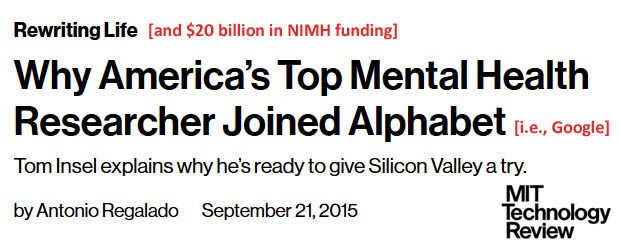
Then along comes a startup tech company called Mindstrong, whose Co-Founder and President is none other than Dr. Thomas Insel, former director of NIMH, and one of the chief architects1 of the Research Domain Criteria (RDoC), “a research framework for new approaches to investigating mental disorders” that eschews the DSM-5 diagnostic bible. The Appendix chronicles the timeline of Dr. Insel's evolution from “mindless” RDoC champion to “brainless” wearables/smartphone tech proselytizer.2


From Wired:
. . .

At Mindstrong, one of the first tests of the [“digital phenotype”] concept will be a study of how 600 people use their mobile phones, attempting to correlate keyboard use patterns with outcomes like depression, psychosis, or mania. “The complication is developing the behavioral features that are actionable and informative,” Insel says. “Looking at speed, looking at latency or keystrokes, looking at error—all of those kinds of things could prove to be interesting.”

Curiously, in their list of digital biomarkers, they differentiate between executive function and cognitive control — although their definitions were overlapping (see my previous post, Is executive function different from cognitive control? The results of an informal poll).
Mindstrong tracks five digital biomarkers associated with brain health: Executive function, cognitive control, working memory, processing speed, and emotional valence. These biomarkers are generated from patterns in smartphone use such as swipes, taps, and other touchscreen activities, and are scientifically validated to provide measurements of cognition and mood.

Whither RDoC?

NIMH established a mandate requiring that all clinical trials should postulate a neural circuit “mechanism” that would be responsible for any efficacious response. Thus, clinical investigators were forced to make up simplistic biological explanations for their psychosocial interventions:

“I hypothesize that the circuit mechanism for my elaborate new psychotherapy protocol which eliminates fear memories (e.g., specific phobias, PTSD) is implemented by down-regulation of amygdala activity while participants view pictures of fearful faces using the Hariri task.”


[a fictitious example]


I'm including a substantial portion of the February 27, 2014 text here because it's important.
NIMH is making three important changes to how we will fund clinical trials.

First, future trials will follow an experimental medicine approach in which interventions serve not only as potential treatments, but as probes to generate information about the mechanisms underlying a disorder. Trial proposals will need to identify a target or mediator; a positive result will require not only that an intervention ameliorated a symptom, but that it had a demonstrable effect on a target, such as a neural pathway implicated in the disorder or a key cognitive operation. While experimental medicine has become an accepted approach for drug development, we believe it is equally important for the development of psychosocial treatments. It offers us a way to understand the mechanisms by which these treatments are leading to clinical change.

OK, so the target could be a key cognitive operation. But let's say your intervention is a Housing First initiative in homeless individuals with severe mental illness and co-morbid substance abuse. Your manipulation is to compare quality of life outcomes for Housing First with Assertive Community Treatment vs. Congregate Housing with on-site supports vs. treatment as usual. What is the key cognitive operation here? Fortunately, this project was funded by the Canadian government and did not need to compete for NIMH funding.

I think my ultimate issue is one of fundamental fairness. Is it OK to skate away from the wreckage and profit by making millions of dollars? From Wired:
“I spent 13 years at NIMH really pushing on the neuroscience and genetics of mental disorders, and when I look back on that I realize that while I think I succeeded at getting lots of really cool papers published by cool scientists at fairly large costs—I think $20 billion—I don’t think we moved the needle in reducing suicide, reducing hospitalizations, improving recovery for the tens of millions of people who have mental illness,” Insel says. “I hold myself accountable for that.”

But how? You've admitted to spending $20 billion on cool projects and cool papers and cool scientists who do basic research. This has great value. But the big mistakes were an unrealistic promise of treatments and cures, and the charade of forcing scientists who study C. elegans to explain how they're going to cure psychiatric disorders.


Footnotes

1 Dr. Bruce Cuthbert was especially instrumental, as well as a large panel of experts. But since this post is about digital biomarkers, the former director of NIMH is the focus of RDoC here.

2 The Insel archives of the late Dr. Mickey Nardo in his prolific blog, 1boringoldman.com, are a must-read. I also wish the late Dr. Barney Carroll was still here to issue his trenchant remarks and trademark witticisms.


Reference

Kirkby LA, Luongo FJ, Lee MB, Nahum M, Van Vleet TM, Rao VR, Dawes HE, Chang EF, Sohal VS. (2018). An Amygdala-Hippocampus Subnetwork that Encodes Variation in Human Mood. Cell 175(6):1688-1700.e14.


Additional Reading - Digital Phenotyping

Jain SH, Powers BW, Hawkins JB, Brownstein JS. (2015). The digital phenotype. Nat Biotechnol. 33(5):462-3. [usage of the term here means data mining of content such as Twitter and Google searches, rather than physical interactions with a smartphone]

Insel TR. (2017). Digital Phenotyping: Technology for a New Science of Behavior. JAMA 318(13):1215-1216. [smartphone swipes, NOT content: “Who would have believed that patterns of typing and scrolling could reveal individual fingerprints of performance, capturing our neurocognitive function continuously in the real world?”]

Insel TR. (2017). Join the disruptors of health science. Nature 551(7678):23-26. [conversion to the SF Bay Area/Silicon Valley mindset]. Key quote:
“But what struck me most on moving from the Beltway to the Bay Area was that, unlike pharma and biotech, tech companies enter biomedical and health research with a pedigree of software research and development, and a confident, even cocky, spirit of disruption and innovation. They have grown by learning how to move quickly from concept to execution. Software development may generate a minimally viable product within weeks. That product can be refined through ‘dogfooding’ (testing it on a few hundred employees, families or friends) in a month, then released to thousands of users for rapid iterative improvement.”
[is ‘dogfooding’ a real term?? if that's how you're going to test technology designed to help people with severe mental illnesses — without the input of the consumers themselves — YOU WILL BE DOOMED TO FAILURE.]

Philip P, De-Sevin E, Micoulaud-Franchi JA. (2018). Technology as a Tool for Mental Disorders. JAMA 319(5):504.

Insel TR. (2018). Technology as a Tool for Mental Disorders-Reply. JAMA  319(5):504.

Insel TR. (2018). Digital phenotyping: a global tool for psychiatry. World Psychiatry 17(3):276-277.


Appendix - a selective history of RDoC publications


Post-NIMH Transition (articles start appearing less than a month later) 


Subscribe to Post Comments [Atom]

Sunday, August 09, 2015

Will machine learning create new diagnostic categories, or just refine the ones we already have?


How do we classify and diagnose mental disorders?

In the coming era of Precision Medicine, we'll all want customized treatments that “take into account individual differences in people’s genes, environments, and lifestyles.” To do this, we'll need precise diagnostic tools to identify the specific disease process in each individual. Although focused on cancer in the near-term, the longer-term goal of the White House initiative is to apply Precision Medicine to all areas of health. This presumably includes psychiatry, but the links between Precision Medicine, the BRAIN initiative, and RDoC seem a bit murky at present.1

But there's nothing a good infographic can't fix. Science recently published a Perspective piece by the NIMH Director and the chief architect of the Research Domain Criteria (RDoC) initiative (Insel & Cuthbert, 2015). There's Deconstruction involved, so what's not to like? 2


ILLUSTRATION: V. Altounian and C. Smith / SCIENCE


In this massively ambitious future scenario, the totality of one's genetic risk factors, brain activity, physiology, immune function, behavioral symptom profile, and life experience (social, cultural, environmental) will be deconstructed and stratified and recompiled into a neat little cohort. 3

The new categories will be data driven. The project might start by collecting colossal quantities of expensive data from millions of people, and continue by running classifiers on exceptionally powerful computers (powered by exceptionally bright scientists/engineers/coders) to extract meaningful patterns that can categorize the data with high levels of sensitivity and specificity. Perhaps I am filled with pathologically high levels of negative affect (Loss? Frustrative Nonreward?), but I find it hard to be optimistic about progress in the immediate future. You know, for a Precision Medicine treatment for me (and my pessimism)...

But seriously.

Yes, RDoC is ambitious (and has its share of naysayers). But what you may not know is that it's also trendy! Just the other day, an article in The Atlantic explained Why Depression Needs A New Definition (yes, RDoC) and even cited papers like Depression: The Shroud of Heterogeneity. 4

But let's just focus on the brain for now. For a long time, most neuroscientists have viewed mental disorders as brain disorders. [But that's not to say that environment, culture, experience, etc. play no role! cf. Footnote 3]. So our opening question becomes, How do we classify and diagnose brain disorders neural circuit disorders in a fashion consistent with RDoC principles? Is there really One Brain Network for All Mental Illness, for instance? (I didn't think so.)

Our colleagues in Asia and Australia and Europe and Canada may not have gotten the funding memo, however, and continue to run classifiers based on DSM categories. 5 In my previous post, I promised an unsystematic review of machine learning as applied to the classification of major depression. You can skip directly to the Appendix to see that.

Regardless of whether we use DSM-5 categories or RDoC matrix constructs, what we need are robust and reproducible biomarkers (see Table 1 above). A brief but excellent primer by Woo and Wager (2015) outlined the characteristics of a useful neuroimaging biomarker:
1. Criterion 1: diagnosticity

Good biomarkers should produce high diagnostic performance in classification or prediction. Diagnostic performance can be evaluated by sensitivity and specificity. Sensitivity concerns whether a model can correctly detect signal when signal exists. Effect size is a closely related concept; larger effect sizes are related to higher sensitivity. Specificity concerns whether the model produces negative results when there is no signal. Specificity can be evaluated relative to a range of specific alternative conditions that may be confusable with the condition of interest.

2. Criterion 2: interpretability

Brain-based biomarkers should be meaningful and interpretable in terms of neuroscience, including previous neuroimaging studies and converging evidence from multiple sources (eg, animal models, lesion studies, etc). One potential pitfall in developing neuroimaging biomarkers is that classification or prediction models can capitalize on confounding variables that are not neuroscientifically meaningful or interesting at all (eg, in-scanner head movement). Therefore, neuroimaging biomarkers should be evaluated and interpreted in the light of existing neuroscientific findings.

3. Criterion 3: deployability

Once the classification or outcome-prediction model has been developed as a neuroimaging biomarker, the model and the testing procedure should be precisely defined so that it can be prospectively applied to new data. Any flexibility in the testing procedures could introduce potential overoptimistic biases into test results, rendering them useless and potentially misleading. For example, “amygdala activity” cannot be a good neuroimaging biomarker without a precise definition of which “voxels” in the amygdala should be activated and the relative expected intensity of activity across each voxel. A well-defined model and standardized testing procedure are crucial aspects of turning neuroimaging results into a “research product,” a biomarker that can be shared and tested across laboratories.

4. Criterion 4: generalizability

Clinically useful neuroimaging biomarkers aim to provide predictions about new individuals. Therefore, they should be validated through prospective testing to prove that their performance is generalizable across different laboratories, different scanners or scanning procedures, different populations, and variants of testing conditions (eg, other types of chronic pain). Generalizability tests inherently require multistudy and multisite efforts. With a precisely defined model and standardized testing procedure (criterion 3), we can easily test the generalizability of biomarkers and define the boundary conditions under which they are valid and useful.
[Then the authors evaluated the performance of a structural MRI signature for IBS presented in an accompanying paper.]

Should we try to improve on a neuroimaging biomarker (or “neural signature”) for classic disorders in which “Neuroanatomical diagnosis was correct in 80% and 72% of patients with major depression and schizophrenia, respectively...” (Koutsouleris et al., 2015)? That study used large cohorts and evaluated the trained biomarker against an independent validation database (i.e., it was more thorough than many other investigations). Or is the field better served by classifying when loss and agency and auditory perception go awry? What would individualized treatments for these constructs look like? Presumably, the goal is to develop better treatments, and to predict who will respond to a specific treatment(s).

OR should we adopt the surprisingly cynical view of some prominent investigators, who say:
...identifying a genuine neural signature would necessitate the discovery of a specific pattern of brain responses that possesses nearly perfect sensitivity and specificity for a given condition or other phenotype. At the present time, neuroscientists are not remotely close to pinpointing such a signature for any psychological disorder or trait...

If that's true, then we'll have an awfully hard time with our resting state fMRI classifier for neuro-nihilism.


Footnotes

1 Although NIMH Mad Libs does a bang up job...

2 Derrida's Deconstruction and RDoc are diametrically opposed, as irony would have it.

3 Or maybe an n of 1...  I'm especially curious about how life experience will be incorporated into the mix. Perhaps the patient of the future will upload all the data recorded by their memory implants, as in The Entire History of You (an episode of Black Mirror).

4 The word “shroud” always makes everything sound so dire and deathly important... especially when used as a noun.

5 As do many research groups in the US. This is meant to be snarky, but not condescending to anyone who follows DSM-5 in their research.


References

Insel, T., & Cuthbert, B. (2015). Brain disorders? Precisely. Science, 348 (6234), 499-500 DOI: 10.1126/science.aab2358

Woo, C., & Wager, T. (2015). Neuroimaging-based biomarker discovery and validation. PAIN, 156 (8), 1379-1381 DOI: 10.1097/j.pain.0000000000000223


Appendix

Below are 34 references on MRI/fMRI applications of machine learning used to classify individuals with major depression (I excluded EEG/MEG for this particular unsystematic review). The search terms were combinations of "major depression" "machine learning" "support vector" "classifier".

Here's a very rough summary of methods:

Structural MRI: 1, 14, 22, 29, 31, 32

DTI: 6, 12, 18, 19

Resting State fMRI: 3, 5, 8, 9 11, 16, 17, 21, 28, 33

fMRI while viewing different facial expressions: 2, 7, 10, 24, 26, 27, 34

comorbid panic: 13

verbal working memory: 25

guilt: 15 (see The Idiosyncratic Side of Diagnosis by Brain Scan and Machine Learning)

Schizophrenia vs. Bipolar vs. Schizoaffective: 16

Psychotic Major Depression vs. Bipolar Disorder: 20

Schizophrenia vs. Major Depression: 23, 31

Unipolar vs. Bipolar Depression: 24, 32, 34

This last one is especially important, since an accurate diagnosis can avoid the potentially disastrous prescribing of antidepressants in bipolar depression.

Idea that may already be implemented somewhere: Individual labs or research groups could perhaps contribute to a support vector machine clearing house (e.g., at NTRIC or OpenfMRI or GitHub) where everyone can upload the code for data processing streams and various learning/classification algorithms to try out on each others' data.

1.
Brain. 2012 May;135(Pt 5):1508-21. doi: 10.1093/brain/aws084.
Multi-centre diagnostic classification of individual structural neuroimaging scans from patients with major depressive disorder.
Mwangi B Ebmeier KP, Matthews K, Steele JD.

2.
Bipolar Disord. 2012 Jun;14(4):451-60. doi: 10.1111/j.1399-5618.2012.01019.x.
Pattern recognition analyses of brain activation elicited by happy and neutral faces in unipolar and bipolar depression.
Mourão-Miranda J Almeida JR, Hassel S, de Oliveira L, Versace A, Marquand AF, Sato JR, Brammer M, Phillips ML.

3.
PLoS One. 2012;7(8):e41282. doi: 10.1371/journal.pone.0041282. Epub 2012 Aug 20.
Changes in community structure of resting state functional connectivity in unipolar depression.
Lord A Horn D, Breakspear M, Walter M.

5.
Neuroreport. 2012 Dec 5;23(17):1006-11. doi: 10.1097/WNR.0b013e32835a650c.
Machine learning classifier using abnormal brain network topological metrics in major depressive disorder.
Guo H Cao X, Liu Z, Li H, Chen J, Zhang K.

6.
PLoS One. 2012;7(9):e45972. doi: 10.1371/journal.pone.0045972. Epub 2012 Sep 26.
Increased cortical-limbic anatomical network connectivity in major depression revealed by diffusion tensor imaging.
Fang P Zeng LL, Shen H, Wang L, Li B, Liu L, Hu D.

7.
PLoS One. 2013;8(4):e60121. doi: 10.1371/journal.pone.0060121. Epub 2013 Apr 1.
What does brain response to neutral faces tell us about major depression? evidence from machine learning and fMRI.
Oliveira L Ladouceur CD, Phillips ML, Brammer M, Mourao-Miranda J.

8.
Hum Brain Mapp. 2014 Apr;35(4):1630-41. doi: 10.1002/hbm.22278. Epub 2013 Apr 24.
Unsupervised classification of major depression using functional connectivity MRI.
Zeng LL Shen H, Liu L, Hu D.

9.
Psychiatry Clin Neurosci. 2014 Feb;68(2):110-9. doi: 10.1111/pcn.12106. Epub 2013 Oct 31.
Aberrant functional connectivity for diagnosis of major depressive disorder: a discriminant analysis.

10.
Neuroimage. 2015 Jan 15;105:493-506. doi: 10.1016/j.neuroimage.2014.11.021. Epub 2014 Nov 15.
Sparse network-based models for patient classification using fMRI.
Rosa MJ Portugal L Hahn T Fallgatter AJ Garrido MI Shawe-Taylor J Mourao-Miranda J.

11.
Proc IEEE Int Symp Biomed Imaging. 2014 Apr;2014:246-249.
ELUCIDATING BRAIN CONNECTIVITY NETWORKS IN MAJOR DEPRESSIVE DISORDER USING CLASSIFICATION-BASED SCORING.
Sacchet MD Prasad G Foland-Ross LC Thompson PM Gotlib IH.

12.
Front Psychiatry. 2015 Feb 18;6:21. doi: 10.3389/fpsyt.2015.00021. eCollection 2015.
Support vector machine classification of major depressive disorder using diffusion-weighted neuroimaging and graph theory.
Sacchet MD Prasad G Foland-Ross LC Thompson PM Gotlib IH.

13.
J Affect Disord. 2015 Sep 15;184:182-92. doi: 10.1016/j.jad.2015.05.052. Epub 2015 Jun 6.
Separating depressive comorbidity from panic disorder: A combined functional magnetic resonance imaging and machine learning approach.
Lueken U Straube B Yang Y Hahn T Beesdo-Baum K Wittchen HU Konrad C Ströhle A Wittmann A Gerlach AL Pfleiderer B, Arolt V, Kircher T.

14.
PLoS One. 2015 Jul 17;10(7):e0132958. doi: 10.1371/journal.pone.0132958. eCollection 2015.
Structural MRI-Based Predictions in Patients with Treatment-Refractory Depression (TRD).
Johnston BA Steele JD Tolomeo S Christmas D Matthews K.

15.
Psychiatry Res. 2015 Jul 5. pii: S0925-4927(15)30025-1. doi: 10.1016/j.pscychresns.2015.07.001. [Epub ahead of print]
Machine learning algorithm accurately detects fMRI signature of vulnerability to major depression.
Sato JR Moll J Green S Deakin JF Thomaz CE Zahn R.

16.
Neuroimage. 2015 Jul 24. pii: S1053-8119(15)00674-6. doi: 10.1016/j.neuroimage.2015.07.054. [Epub ahead of print]
A group ICA based framework for evaluating resting fMRI markers when disease categories are unclear: Application to schizophrenia, bipolar, and schizoaffective disorders.
Du Y Pearlson GD Liu J Sui J Yu Q He H Castro E Calhoun VD.

17.
Neuroreport. 2015 Aug 19;26(12):675-80. doi: 10.1097/WNR.0000000000000407.
Predicting clinical responses in major depression using intrinsic functional connectivity.
Qin J, Shen H, Zeng LL, Jiang W, Liu L, Hu D.

18.
J Affect Disord. 2015 Jul 15;180:129-37. doi: 10.1016/j.jad.2015.03.059. Epub 2015 Apr 4.
Altered anatomical patterns of depression in relation to antidepressant treatment: Evidence from a pattern recognition analysis on the topological organization of brain networks.
Qin J, Wei M, Liu H Chen J Yan R Yao Z Lu Q.

19.
Magn Reson Imaging. 2014 Dec;32(10):1314-20. doi: 10.1016/j.mri.2014.08.037. Epub 2014 Aug 29.
Abnormal hubs of white matter networks in the frontal-parieto circuit contribute to depression discrimination via pattern classification.
Qin J, Wei M, Liu H Chen J Yan R Hua L Zhao K Yao Z Lu Q.

20.
Biomed Res Int. 2014;2014:706157. doi: 10.1155/2014/706157. Epub 2014 Jan 19.
Neuroanatomical classification in a population-based sample of psychotic major depression and bipolar I disorder with 1 year of diagnostic stability.
Serpa MH, Ou Y Schaufelberger MS Doshi J Ferreira LK Machado-Vieira R Menezes PR Scazufca M Davatzikos C Busatto GF Zanetti MV.

21.
Psychiatry Res. 2013 Dec 30;214(3):306-12. doi: 10.1016/j.pscychresns.2013.09.008. Epub 2013 Oct 7.
Identifying major depressive disorder using Hurst exponent of resting-state brain networks.
Wei M Qin J, Yan R, Li H, Yao Z, Lu Q.

22.
J Psychiatry Neurosci. 2014 Mar;39(2):78-86.
Characterization of major depressive disorder using a multiparametric classification approach based on high resolution structural images.
Qiu L Huang X Zhang J Wang Y Kuang W Li J Wang X Wang L Yang X Lui S Mechelli A Gong Q2.

23.
PLoS One. 2013 Jul 2;8(7):e68250. doi: 10.1371/journal.pone.0068250. Print 2013.
Convergent and divergent functional connectivity patterns in schizophrenia and depression.
Yu Y Shen H, Zeng LL, Ma Q, Hu D.

24.
Eur Arch Psychiatry Clin Neurosci. 2013 Mar;263(2):119-31. doi: 10.1007/s00406-012-0329-4. Epub 2012 May 26.
Discriminating unipolar and bipolar depression by means of fMRI and pattern classification: a pilot study.
Grotegerd D Suslow T, Bauer J, Ohrmann P, Arolt V, Stuhrmann A, Heindel W, Kugel H, Dannlowski U.

25.
Neuroreport. 2008 Oct 8;19(15):1507-11. doi: 10.1097/WNR.0b013e328310425e.
Neuroanatomy of verbal working memory as a diagnostic biomarker for depression.
Marquand AF Mourão-Miranda J, Brammer MJ, Cleare AJ, Fu CH.

26.
Biol Psychiatry. 2008 Apr 1;63(7):656-62. Epub 2007 Oct 22.
Pattern classification of sad facial processing: toward the development of neurobiological markers in depression.
Fu CH Mourao-Miranda J, Costafreda SG, Khanna A, Marquand AF, Williams SC, Brammer MJ.

27.
Neuroreport. 2009 May 6;20(7):637-41. doi: 10.1097/WNR.0b013e3283294159.
Neural correlates of sad faces predict clinical remission to cognitive behavioural therapy in depression.
Costafreda SG Khanna A, Mourao-Miranda J, Fu CH.

28.
Magn Reson Med. 2009 Dec;62(6):1619-28. doi: 10.1002/mrm.22159.
Disease state prediction from resting state functional connectivity.
Craddock RC Holtzheimer PE 3rd, Hu XP, Mayberg HS.

29.
Neuroimage. 2011 Apr 15;55(4):1497-503. doi: 10.1016/j.neuroimage.2010.11.079. Epub 2010 Dec 3.
Prognostic prediction of therapeutic response in depression using high-field MR imaging.
Gong Q Wu Q, Scarpazza C, Lui S, Jia Z, Marquand A, Huang X, McGuire P, Mechelli A.

30.
Neuroimage. 2012 Jun;61(2):457-63. doi: 10.1016/j.neuroimage.2011.11.002. Epub 2011 Nov 7.
Diagnostic neuroimaging across diseases.
Klöppel S Abdulkadir A, Jack CR Jr, Koutsouleris N, Mourão-Miranda J, Vemuri P.

31.
Brain. 2015 Jul;138(Pt 7):2059-73. doi: 10.1093/brain/awv111. Epub 2015 May 1.
Individualized differential diagnosis of schizophrenia and mood disorders using neuroanatomical biomarkers.
Koutsouleris N Meisenzahl EM Borgwardt S Riecher-Rössler A Frodl T Kambeitz J Köhler Y Falkai P Möller HJ Reiser M Davatzikos C.

32.
JAMA Psychiatry. 2014 Nov;71(11):1222-30. doi: 10.1001/jamapsychiatry.2014.1100.
Brain morphometric biomarkers distinguishing unipolar and bipolar depression. A voxel-based morphometry-pattern classification approach.
Redlich R Almeida JJ Grotegerd D Opel N Kugel H Heindel W Arolt V Phillips ML Dannlowski U.

33.
Brain Behav. 2013 Nov;3(6):637-48. doi: 10.1002/brb3.173. Epub 2013 Sep 22.
A reversal coarse-grained analysis with application to an altered functional circuit in depression.
Guo S Yu Y Zhang J Feng J.

34.
Hum Brain Mapp. 2014 Jul;35(7):2995-3007. doi: 10.1002/hbm.22380. Epub 2013 Sep 13.
Amygdala excitability to subliminally presented emotional faces distinguishes unipolar and bipolar depression: an fMRI and pattern classification study.
Grotegerd D Stuhrmann A, Kugel H, Schmidt S, Redlich R, Zwanzger P, Rauch AV, Heindel W, Zwitserlood P, Arolt V, Suslow T, Dannlowski U.

Subscribe to Post Comments [Atom]

eXTReMe Tracker